Skip to content
Explore red light therapy devices designed for everyday use.
Sound familiar?
Find your story below.
Sleep & Exhaustion
You've tried the routines. No screens before bed. Magnesium. The expensive pillow. The sleep tracking app that just confirms what you already know — you're not getting real rest.
You fall asleep fine. But somewhere between lights out and morning, your body stops actually recovering. That's not a discipline problem. That's a biology problem.
You don't want to sleep more. You want your sleep to actually count.
Pain & Inflammation
It's not dramatic. It's not injury-level. It's a persistent tightness in your neck, a stiffness in your back every morning, knees that remind you they exist after a long day.
You've tried the creams. The heating pads. The stretching routines. The relief never lasts past the treatment — because none of it reaches the inflammation underneath.
You just want to move through your day without your body being the loudest thing in the room.
Skin & Fine Lines
Fine lines you didn't notice a year ago. A dullness that no amount of moisturizer seems to lift. You're doing the routine — the serums, the SPF, the eye cream.
And still, something in the mirror has shifted that topical products can't reach. Collagen production doesn't slow down because of what you're putting on your skin. It slows down despite it.
You're not trying to reverse time. You just want your face to match how you actually feel inside.
Energy & Recovery
You're still showing up — still moving, still trying. But recovery takes longer than it used to. You're sore when you shouldn't be, tired when you should have bounced back.
That's not weakness. That's inflammation and cellular energy running low — and no amount of coffee or rest days fully closes the gap.
You want your body to keep up with your life again. Not lag two days behind it.
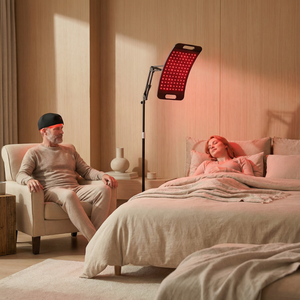
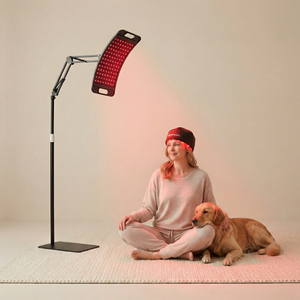
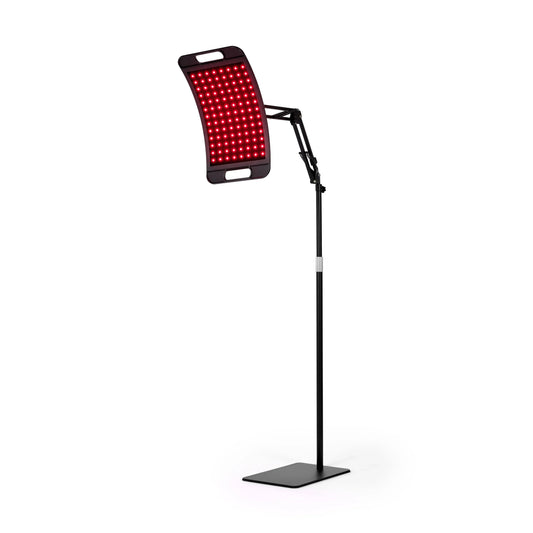
Most wellness habits fail because they ask too much from the part of you that's already depleted. This one doesn't. Position the lamp, sit back, and let it run — it shuts off on its own. No technique to learn, no prep, no cleanup. Most people use it while they're already winding down for the evening — on the couch, at their desk, in bed. The lamp fits into the life you already have. That's the reason it works.
What to expect
Light therapy works the way your body heals — gradually and from the inside out. Here's what consistent use actually looks like.
Sleep feels a little deeper. Morning stiffness eases a few minutes faster. Energy is slightly more stable through the afternoon. Nothing dramatic — but something has quietly shifted. That's your cells responding. The process has started.
Skin looks visibly brighter and more even. Pain that was always background noise starts to quiet. Recovery from workouts or long days is measurably faster. This is your inflammation reducing, your collagen rebuilding, your circadian rhythm resetting. Keep going.
By this stage, most users don't think of it as therapy anymore — it's just the part of their evening they protect. Sleep is consistently better. Body feels more resilient. Skin looks like it did years ago. The results aren't dramatic because they happened the same way your body works — gradually, genuinely, and built to last.
Clinic-grade results. Without the clinic price tag.
Most lamps give you half the light and twice the frustration.
Full 312 LEDs
Both 660nm red and 850nm near-infrared
360° adjustable arm — treat anywhere, stay seated
Pays for itself in one clinic session
Questions worth asking
Red light therapy has over 3,000 peer-reviewed clinical studies behind it and has been used in hospitals, physiotherapy clinics, and dermatology practices for decades — long before it became a consumer product category. The specific wavelengths this lamp uses — 660nm and 850nm — have the strongest evidence base of any in the spectrum. What separates clinical-grade devices from cheap alternatives is LED count, output power, and wavelength precision. At 312 LEDs with dual-wavelength output, the Nicebeam delivers the same light parameters clinicians use professionally.
A single physiotherapy red light session typically costs $60–$120. One session at a skin clinic: $100–$250. The Nicebeam is a one-time purchase that delivers the same clinical wavelengths at home, every day, indefinitely. Most users recoup the full cost within the first three weeks they would otherwise have spent on clinic visits, pain relief products, or sleep supplements. After that, every session is free.
Sleep and energy changes tend to come first — most users feel a difference within 1–2 weeks of consistent evening use. Pain and inflammation reduction typically follows at 2–4 weeks. Skin improvements — collagen, tone, fine lines — build over 4–8 weeks as cellular repair accumulates. These are the timelines consistent users report. If you use it twice a week, results take longer. If you use it 4–5 nights a week, results arrive closer to the shorter end.
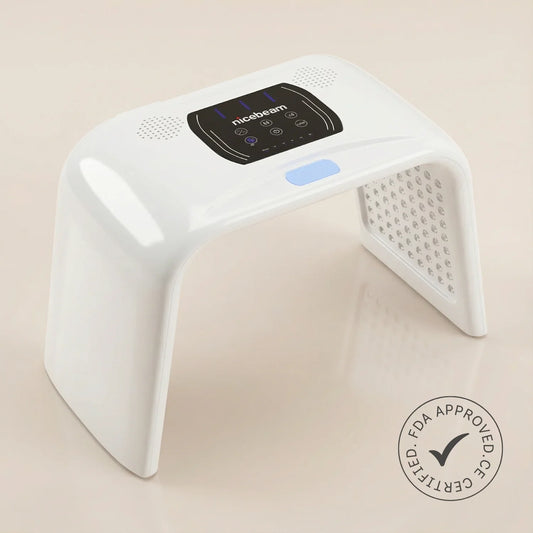
Yes. The lamp is FDA Registered and CE Certified — both of which require demonstrating safety for independent consumer use. The light is non-thermal and non-ablative — it doesn't generate damaging heat and doesn't break the skin's surface. Included eye goggles protect against direct light exposure during sessions. The one precaution worth noting: if you're on photosensitizing medication — certain antibiotics, retinoids, or treatments that increase light sensitivity — check with your doctor before starting.
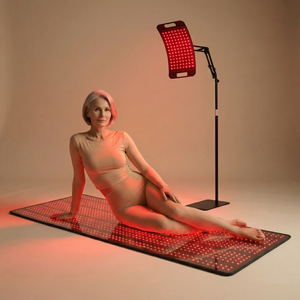
The adjustable arm rotates and tilts to reach virtually any area — face, neck, shoulders, back, chest, stomach, legs, and joints. Most users treat 1–2 areas per session depending on what needs attention that day. You're not limited to a single treatment zone, and you don't need to reposition the base to switch areas — just rotate the arm. It genuinely covers full-body use from a single standing position.