Skip to content
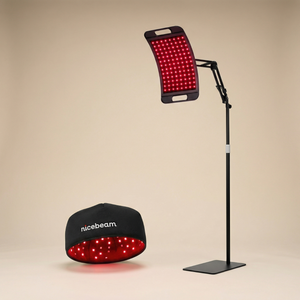
Explore red light therapy devices designed for everyday use.
Sound familiar?
Find your story below.
Hair Thinning & Regrowth
It started gradually — a little more on the brush, a little less in the ponytail. Now you find yourself angling photos and avoiding certain lighting.
You've tried biotin. Scalp serums. The expensive shampoo. None of it grew back what you lost.
You're not asking for miracles. You just want your hair to feel like yours again.
Fine Lines & Collagen
Around the eyes first. Then the forehead. You moisturize every day, you wear SPF — and still, the mirror shows something that wasn't there two years ago.
Creams sit on the surface. They can't reach the dermis where collagen is actually made.
You're not chasing 25. You just want to look like a rested version of yourself.
Glow & Skin Tone
Now it looks flat. Uneven. Like it's working hard just to look okay. You've spent more on your skincare shelf than you'd like to admit — and the glow still isn't there.
The problem isn't your products. It's that cellular turnover slows with age — and no serum can fix that from the outside.
You want skin that looks alive again. Not just moisturized.
Breakouts & Sensitivity
Adult breakouts weren't part of the plan. Neither was the persistent redness that won't calm down — no matter how gentle you go with your routine.
You've tried eliminating everything. Adding things back. It still flares up at the worst possible time.
You want skin that's calm, clear, and consistent — not a coin flip every morning.
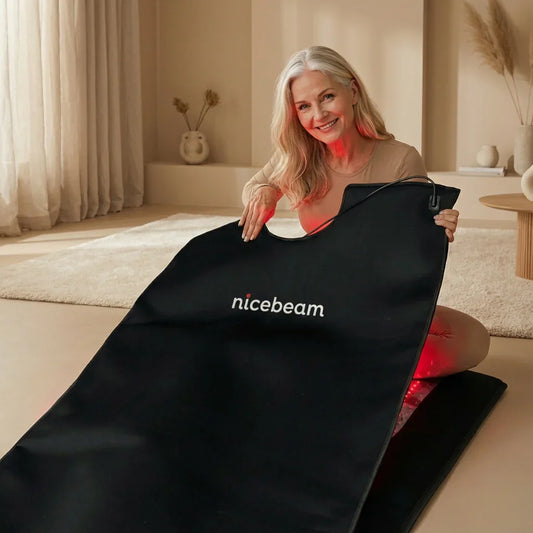
That's all it takes. Lie flat, press a button, let the light work. By the time your favorite show's opening credits finish, your muscles are recovering, your skin is rebuilding collagen, and your body is resetting for tomorrow. No drive, no changing rooms, no appointment. Just 20 minutes you were probably spending on your phone anyway.
Light therapy works the way your skin does — gradually, from the inside out. Here's what consistent use actually looks like.
Skin feels calmer and more hydrated after the first few sessions. Redness settles. Sensitivity eases. Nothing dramatic yet — but something has quietly shifted.
Brightness returns. Texture smooths out. Fine lines look softer — not erased, but noticeably less carved in. For hair, the shedding slows and the scalp feels healthier. This is your collagen production restarting.
This is the stage people notice out loud. Skin tone is consistently even, hair looks visibly fuller at thinning areas, and the glow isn't something you have to create anymore — it's just there.
Pick the color that matches what you're fighting today – breakouts, redness, fine lines, or just "tired face" and let the device do the work while you relax.
Red + Near-Infrared
660 nm + 850 nm
Laser Mode
850–905 nm
Blue + Purple
415 nm + 405 nm
Green
525 nm
Yellow + Cyan
590 nm + 490 nm
Turquoise
470 nm
White
Full-Spectrum
Use this when you look tired or dull and want more bounce and glow. This mode helps soften the look of fine lines and supports smoother-looking skin over time. Most people make this their go-to nightly ritual because it simply works.
Use on thinning spots or weak regrowth areas. This mode supports hair follicle performance over time so strands look thicker, stronger, and more resilient. Consistency matters here – think weeks, not days.
Use when a breakout is forming or lingering marks won't fade. This mode helps target acne-causing bacteria while supporting a more even look as blemishes heal. Perfect for "I can feel something coming" days.
Use when your skin feels greasy by lunch or textured in the mirror. This mode supports a more balanced look without drying your face out. Great before makeup or anytime you want a smoother, cleaner canvas.
Use when you're dealing with irritation, sensitivity, or uneven tone. This mode helps calm the look of redness and brings your skin back to neutral. Ideal after harsh skincare, cold weather, or sun.
Use when your skin feels irritated, tight, or overreacting to everything. This mode supports recovery and helps your complexion look calmer. If your skin has mood swings, this mode is the reset button.
Use when you want results but don't want to pick a lane. This all-in-one mode supports overall clarity, tone, and complexion health in one session. Great for maintenance or overwhelmed beginners.
One device. Every other brand needs three.
Clinical results. Home convenience. One price.
Skin, hair, and hydration — covered
Clinician-backed, FDA registered
Pays for itself in two clinic visits
Works while you do nothing
Light therapy isn't new. It's been used in dermatology clinics, hospitals, and sports medicine for decades — with over 3,000 peer-reviewed studies behind it. What's new is having clinical-grade wavelengths in a device you can use at home. The cheap $40 wands you've seen online use underpowered LEDs with no real clinical basis. Nicebeam uses the same wavelengths — 660nm, 850nm — at the same output levels as professional equipment. The science isn't the question. Consistency is.
One professional LED facial: $150–$300. One laser hair growth session: $200–$500. To do both, consistently, at a clinic for three months costs between $1,500 and $5,000. Nicebeam is a one-time cost that delivers the same clinical wavelengths at home, as often as you want, for as long as you own it. Most customers recoup the cost within the first two months they would have otherwise spent on clinic visits. The question isn't whether $599 is worth it. It's whether spending three times that at a clinic is.
Honestly — it depends on what you're treating. Hydration and redness reduction: most users feel a difference within the first week. Skin brightness and fine lines: visible improvement typically starts at 3–4 weeks of consistent use. Hair regrowth: 8–12 weeks, because follicles move through a biological growth cycle that can't be rushed. We say this not to lower expectations — but because the users who know this upfront are the ones who stay consistent long enough to see the full result. The ones who expect week-two hair growth are the ones who quit at week three.
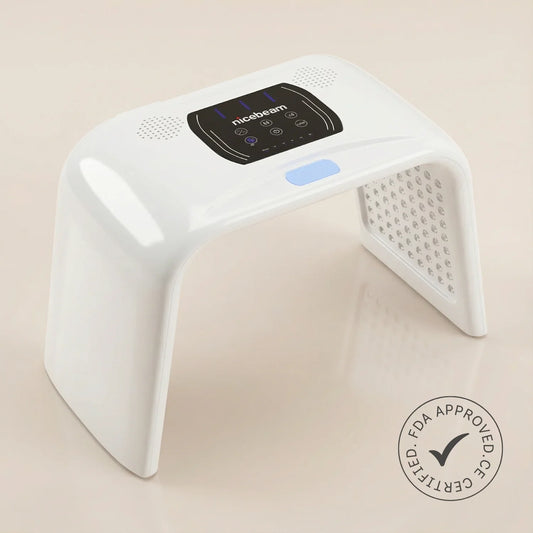
Yes — and the credentials back that up. Nicebeam is FDA Registered and CE Certified, both of which require demonstrating safety for independent consumer use. The light is non-thermal and non-ablative — it doesn't generate damaging heat and doesn't break the skin's surface. The included eye goggles protect against direct light exposure. The auto-timer prevents overexposure. It was specifically designed so that you don't need to be a professional to use it correctly.
Yes — and this is one of the areas where light therapy has a genuine advantage over most skincare treatments. Unlike chemical peels, acids, or laser resurfacing, LED light therapy doesn't remove or damage the skin's surface. It works beneath it. That means there's no risk of post-inflammatory hyperpigmentation — one of the most common concerns for deeper skin tones with other treatments.
For sensitive skin specifically, the yellow and turquoise modes are designed to calm inflammation and reduce reactivity rather than stimulate it. Most users with sensitive skin actually find their baseline reactivity improves over time with consistent use. For combination skin, the green mode targets oil balance without drying out the areas that don't need it.
The one precaution worth noting: if you're on photosensitizing medication — certain antibiotics, retinoids, or acne treatments — consult your doctor before starting. Not because the device is unsafe, but because those medications make any light exposure more intense than intended.